
Future-Proofing Your Business With LED Video Walls
LED video walls deliver measurable engagement, shorten decision cycles, and drive sales lift across locations through targeted content and contextual playlists LED video wall. Strategic deployments balance pixel density, sightlines, and ambient light to match conversion and dwell-time KPIs. Modular cabinets and predictive thermal management reduce downtime and lifecycle costs, while analytics forecast maintenance, energy use, and ROI. Governance frameworks preserve brand consistency with decentralized creative control. Continue for practical design, installation, and measurement guidance.

Why LED Video Walls Are a Strategic Investment
A LED video wall delivers measurable returns by combining high-visibility communication with scalable content control, enabling brands to increase engagement, shorten decision cycles, and drive sales lift across physical locations. It positions companies to leverage audience analytics for targeted messaging, translating observational data into optimized scheduling, content variants, and placement strategies that respect autonomy and choice. Decision-makers see predictable ROI through improved conversion rates and reduced campaign waste, while maintaining brand consistency across regions without centralized bottlenecks. The investment aligns with strategic priorities: measurable performance, agile content governance, and elevated customer experience. For organizations valuing freedom, the solution enables decentralized creative control within guardrails, enabling local teams to respond to market signals while preserving overarching brand standards.
Key Technical Trends Shaping Modern LED Displays
Modern LED video walls are increasingly defined by higher pixel pitch resolutions that enable sharper imagery at closer viewing distances, improving message clarity and audience engagement metrics. Concurrent advances in heat management—including improved thermal conductive materials and active cooling designs—extend component lifespan and reduce maintenance downtime, directly impacting total cost of ownership. Together these trends allow brands to deliver consistent, high-impact visual experiences while optimizing operational efficiency.
Higher Pixel Pitch Resolution
In response to rising expectations for image clarity and brand fidelity, higher pixel pitch resolutions are redefining LED video wall performance by increasing pixel density to deliver sharper visuals at closer viewing distances. Decision-makers prioritize higher density for retail, corporate lobbies, and experiential spaces where pixel optimization translates directly into perceived quality and message impact. Empirical evaluations show reduced minimum viewing distance and measurable gains in legibility for small text and logos, enabling confident brand expression without scale compromise. Strategic deployment uses modular panels that balance resolution against budget and installation constraints, while analytics guide placement to maximize return on attention. The result is freedom to design intimate, immersive displays with fine detailing that reinforce brand identity and strengthen audience engagement.
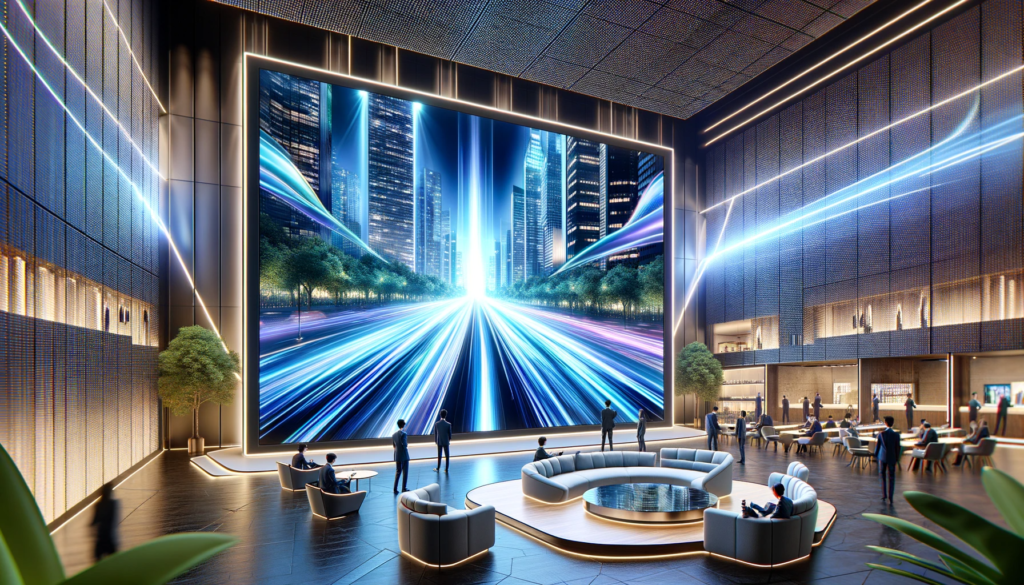
Advanced Heat Management
By prioritizing thermal efficiency through active and passive solutions, advanced heat management has emerged as a critical determinant of LED video wall reliability, lifetime, and visual consistency. Designers implement thermal zoning to isolate hot spots, enabling targeted remediation and preserving uniform brightness across panels. Data-driven modeling predicts heat accumulation under peak loads, guiding materials selection and airflow architecture. Active cooling systems, integrated with sensor feedback, reduce temperature variance and extend diode longevity, supporting predictable maintenance cycles. For brands seeking operational freedom, these strategies minimize downtime and total cost of ownership while protecting image fidelity.
- Use thermal zoning to localize and control heat generation.
- Deploy active cooling with real-time sensor telemetry.
- Validate designs via predictive thermal simulation and field metrics.
Designing for Impact: Size, Resolution, and Placement
Design decisions around LED video walls hinge on ideal size selection to match communication goals and spatial constraints. Data-driven planning of placement and viewing distance maximizes legibility and brand visibility while minimizing pixelation and viewer fatigue. Strategic alignment of scale, resolution, and sightlines guarantees measurable impact on engagement and message retention.
Optimal Size Selection
How large should a video wall be to maximize brand visibility without wasting budget? Ideal size selection balances measurable reach and cost efficiency. Decisions hinge on target impressions, ambient lighting, and venue zoning; choices should enable flexible content strategies while minimizing overspend. Data-driven sizing aligns pixel count to typical content types and expected dwell time. Brand teams gain freedom when scale supports multiple layouts and future upgrades.
- Define KPIs and sightline zones to quantify necessary screen area.
- Match pixel density to content clarity requirements, not maximum specs.
- Budget for modular growth so size can expand with audience demand.
This strategic approach prioritizes ROI, audience impact, and operational agility over one-time visual spectacle.
Placement & Viewing Distance
Placed to intersect natural sightlines and average dwell zones, a video wall’s position and viewing distance determine both message legibility and measured engagement metrics. Strategic placement prioritizes ideal viewing zones—calculated by pixel pitch, screen size, and typical viewer distance—to maximize readability and brand recall. Data-driven site surveys map traffic flows and pause points, informing eye level mounting or raised configurations that respect sightlines while supporting flexible content hierarchies. Brand teams balance visibility with ambiance, reserving higher-resolution panels for close-range interactions and larger-format displays for distant impact. Clear KPIs—view duration, conversion, and dwell distance—validate placement choices and enable iterative optimization. The result is a liberated environment where visual authority aligns with audience movement and commercial objectives.
Content Strategies That Drive Engagement and ROI
When businesses align LED video wall content with clear audience segments and measurable KPIs, they increase engagement and ROI by prioritizing relevance over volume. A strategic, data-driven approach leverages Interactive Scheduling and Contextual Playlists to serve timely, permissioned messaging that respects audience autonomy. Content is tested against conversion, dwell time, and sentiment metrics; successful campaigns trade frequency for resonance, freeing brands to iterate rapidly.
- A/B test formats and CTAs tied to KPI cohorts.
- Use geo- and time-based Contextual Playlists to personalize experiences.
- Deploy Interactive Scheduling to prioritize high-impact windows and consented interactions.
This methodology centers brand clarity, operational flexibility, and accountable measurement, enabling businesses to scale content that consistently drives measurable value.
Installation, Maintenance, and Modular Upgrade Paths
Having established content strategies that prioritize relevance and measurable outcomes, installation, maintenance, and modular upgrade paths become the operational backbone that preserves uptime, visual fidelity, and ROI. A strategic installation plan leverages modular cabinets to enable scalable deployment, simplifying alignment, calibration, and phased expansion without disrupting brand experiences. Proactive maintenance protocols — scheduled diagnostics, spare-part inventories, and remote monitoring — reduce mean time to repair and support consistent pixel performance. Clear service access design, including front and rear entry options, minimizes labor and site constraints while preserving venue flexibility. Upgrade paths prioritize interoperability standards and hot-swappable modules, allowing technology refreshes that protect capital and creative freedom. Decisions are guided by empirical reliability data and brand impact metrics to maximize long-term value.
Measuring Performance: KPIs, Energy Use, and Total Cost of Ownership
How can success be quantified for LED video walls beyond aesthetics? Metrics must tie visual impact to measurable outcomes: engagement rates, energy consumption, and maintenance intervals. A brand-focused evaluation links KPIs to operational efficiency and long-term resilience. Lifecycle analytics inform replacement timing, predict costs, and validate savings from modular upgrades. Decision-makers value freedom to reconfigure displays while controlling overhead.
- Measure audience engagement and conversion uplift against campaign spend.
- Track energy use and cost per operating hour to optimize schedules.
- Use lifecycle analytics to forecast maintenance, parts, and total cost of ownership.
This strategic, data-driven approach enables brands to justify investments, reduce risk, and preserve flexibility without sacrificing performance.
Frequently Asked Questions
How Do LED Video Walls Affect Building Insurance Premiums?
They can trigger higher premiums if insurers view installation and fire/electrical risks as elevated; strategic risk mitigation — documented compliance, warranties, maintenance logs, and certified installers — often lowers perceived exposure and protects brand reputation and autonomy.
Can LED Walls Be Recycled at End of Life?
Yes; they can. Organizations employ recycling processes and component recovery to reclaim LEDs, metals, and PCBs, reducing waste and preserving brand reputation. Data-driven strategies maximize material value while enabling flexible, freedom-oriented sustainability goals.
Do LED Video Walls Interfere With Wireless Signals?
Yes. They can, but typically minimally: electromagnetic compatibility testing reduces interference risk; strategic placement and shielding limit signal attenuation. Data-driven specs guide installation so brands preserve wireless freedom while maintaining reliable connectivity and performance.
What Cybersecurity Risks Do Networked LED Walls Pose?
Networked LED walls risk unauthorized access and data interception, enabling control hijacks, content manipulation, and exfiltration of metrics. The brand must prioritize segmented networks, encryption, and audited access controls to preserve operational freedom and reputation.
Can LED Rentals Be Cost-Effective for Short-Term Events?
Yes: they can be cost-effective. The provider evaluates rental economics and event scalability, offering modular LED packages, transparent pricing, brand-aligned visuals, and data-driven ROI projections so organizers retain creative freedom and financial control.
Conclusion
LED video walls represent a strategic, data-driven investment that aligns brand visibility with measurable ROI. By integrating evolving technical trends—higher pixel density, energy-efficient drivers, and modular architectures—organizations optimize reach, reduce lifecycle costs, and enable scalable content strategies. Strategic placement, resolution choices, and analytics-driven content maximize engagement and conversion. When paired with proactive maintenance and clear KPIs, LED deployments become brand assets that future-proof customer experience, operational efficiency, and long-term total cost of ownership.
…